
Source: http://dnabehavior.com/blogbeta1/10-ways-to-cultural-change/
1. Introduction

Source: https://www.sainsburys.co.uk/
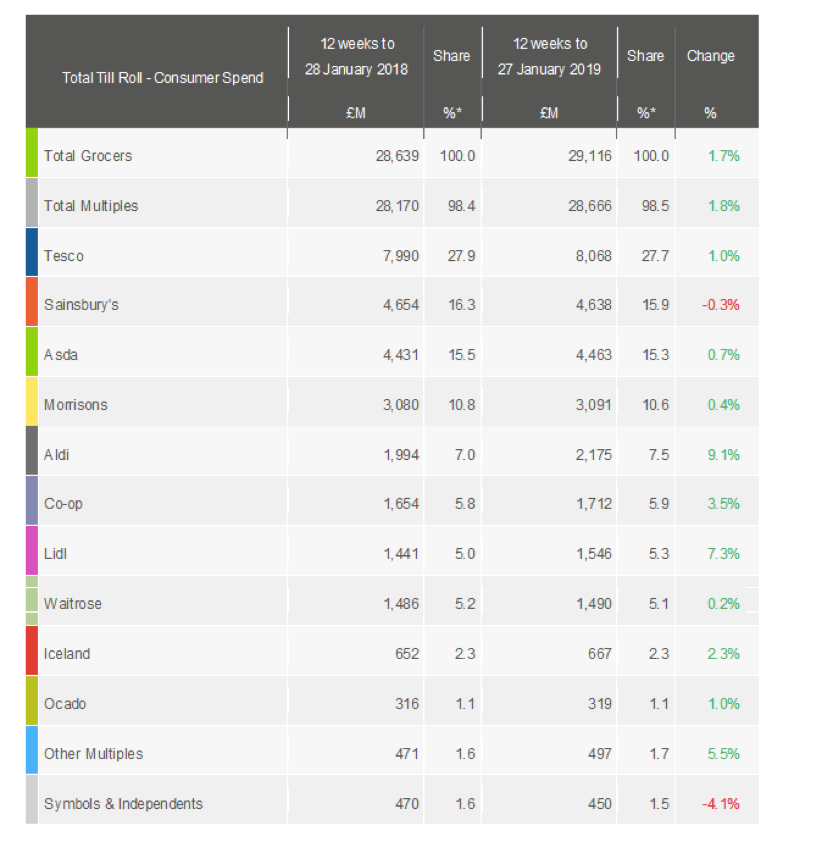
In the first blog, I am asked to provide an explanation on how cultures can be managed within the organizations. I hope that I can gain an insight and enhance my knowledge to become a good and effective leader in the future. I will be using Sainsbury’s, the second largest supermarket in the UK with 16.3% of market share (after Tesco 27.9%, and Asda 15.5%) to illustrate how cultures can be managed within the organizations (Figure 1).
Figure 1: Big Four Supermarkets Start 2019
2. The principal challenges that an organisation faces
Organisational culture has been defined differently in several academic literatures (Deshpande & Webster Jr, 1989). I have chosen the definition given by Sagiv & Schwartz (2007) mentioning organisational culture as the shared insights of organizational workplace within the organisational units. This is supported by McNamara (1999) that this is the organization’s personality in which culture is comprised of the assumptions, values, norms, and tangible signs of a company’s employees and their behaviour. According to Hofstede (1994), culture is the collective programming of the mind which differentiates the member of one group or category of people from another. In other word, culture is the consistent, behavioural patterns which are unique to a specific group. This can be summarised in Figure 2 below.
Figure 2: Organisational culture in an organisation
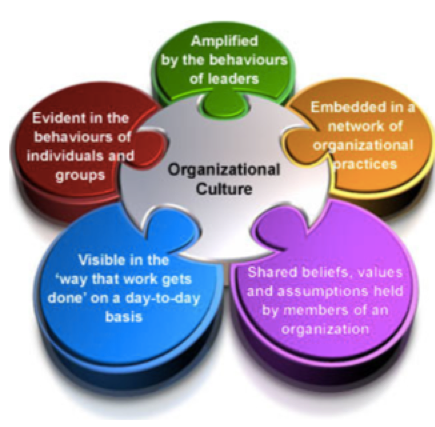
Each organization has a life of its own and often like puzzles compromised of varied little pieces that act as a whole.
3. Implementing change in organizational culture
Most supermarkets including Sainsbury’s to perform wellin this competitive market are forced to change their strategies many times especially when managing organisational culture changes. During transformation/changes, they are faced with two fundamental issues: integrating individuals into the workplace and adapting to the external environment (Armenakis & Bedeian, 1999). It is possible to use Iceberg model to explain the culture change within Sainsbury’s (Figure 3).
Figure 3: Iceberg Model (Herman, 1970)
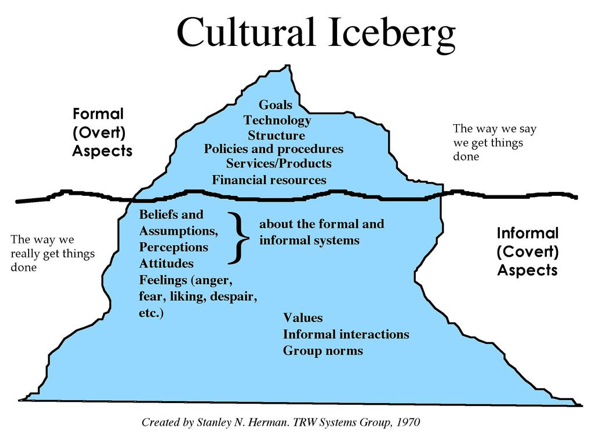
Organizations resemble puzzles which compose of various littles pieces that act as a whole. Most top managers are aware of one-tenth of what is going on in the formal aspect or the way we say we get things done, and consequently fail to identify the bulk that is under water or the way we really get things done. Usually, they cannot change what they do not understand. This is an analogous to a ship heading for an iceberg whereby the long-term sustainability of an organisation relied heavily on the ability of leadership to realise how the organisation should think, feel, and act. As a consequence, they fail to implant necessary changes that have been implemented due to not understanding or acknowledge the basic assumptions in driving the culture.
The iceberg model emphasises on the importance of having a balance between formal and informal aspects of organizational culture.
4. Change of strategy in Sainsbury’s
Sainsbury’s began its operation officially in 1869, and been growing steadily over time. Formerly known as J Sainsbury, in 2018 Sainsbury’s has 606 supermarkets, petrol stations and banks to be found around the Highstreets. Sainsbury’s include 817 Sainsbury’s local, 604 Argos stores, Sainsbury’s Online and Sainsbury Bank. (Sainsbury PLC, 2018 & 2019).
Currently, Sainsbury’s employ over 185,000 colleagues who work hard every to make the customers’ lives easier and to provide them with great products, value for money, and service whenever it is convenient for them. (Sainsbury PLC, 2018 & 2019)
Based on Handy’s four types of organizational culture (1993), Sainsbury’s operated using a role culture which resembles a bureaucratic system whereby the employees are assigned with specific roles and responsibilities. Due to the competitiveness of the market, Sainsbury’s has to adjust and move towards task culture where the employees are more flexible with more freedombeing provided (Handy, 1990). The mission of Sainsbury’s is to ensure that its employees feel valued and motivated. Sainsbury provides a Sainsbury’s Gift Card known as Nectar for employee reward and recognition of their good works and success (Deresky, 2017). Currently, there are 19m collectors and considered the largest loyalty programme in the UK. (Sainsbury PLC, 2019)
5. Managing Culture Effectively
In managing culture effectively, the behaviours of leaders must be amplified and embedded in a network of organizational practices. For any effective leadership, the followers tend to follow their leaders as an example. Sainsbury’s past strategies have been quite outdated; however, the new strategies alone are not enough for survival. Sainsbury’s introduction of employee reward and recognition of good work practice is a starting point to get everyone motivated.
Reference:
Armenakis, A. A., & Bedeian, A. G. (1999). Organizational change: A review of theory and research in the 1990s. Journal of management, 25(3), 293-315.
Deresky, H. (2017). International management: Managing across borders and cultures. Pearson Education India.
Deshpande, R., & Webster Jr, F. E. (1989). Organizational culture and marketing: defining the research agenda. Journal of marketing, 53(1), 3-15.
Handy, C. 1993, Understanding Organizations, Penguin, London.
Herman, S. N. (1970). Cultural Iceberg. TRW Systems Group.
McNamara, C. (1999). General guidelines for conducting interviews.
Reference:
Sagiv, L., & Schwartz, S. H. (2007). Cultural values in organisations: insights for Europe. European Journal of International Management, 1(3), 176-190.
Sainsbury’s Annual Report. (2018). Retrieved from https://www.about.sainsburys.co.uk/~/media/Files/S/Sainsburys/documents/reports-and-presentations/annual-reports/sainsburys-ar-2018-full-report.pdf
Sainsbury’s Annual Report. (2019). Retrieved from https://www.about.sainsburys.co.uk/~/media/Files/S/Sainsburys/documents/reports-and-presentations/Sainsburys-Bank-AR19_FINAL4.pdf
Schein, E. H. (1990). Organizational culture (Vol. 45, No. 2, p. 109). American Psychological Association.
 knowladge
good explanation about organisational culture on Sansbury. Very educational
ถูกใจชื่นชอบโดย 1 คน
I’m glad that you like it, and thank you for your comment
ถูกใจถูกใจ
good explanation on the concepts cover
ถูกใจชื่นชอบโดย 1 คน
Thank you for visit my blog, I’m very happy with your comment and I will very grateful if you want to subscribe my blog for next article of .
ถูกใจถูกใจ
It was such a new and fresh content. I like the idea that you use Sainsbury’s to demonstrate how cultures can be managed within the organizations because it was easy to draw a picture in mind.
ถูกใจชื่นชอบโดย 1 คน
Wow this is surprisingly fresh and insightful, I like it. Please keep it up.
ถูกใจถูกใจ
Thank you for your feedback! In this blog I try to explain organization culture of Sainsbury’s. It’s interested me because Sainsbury’s have different management system if you compare with competitors such as M&s, Spar, Waitrose etc. That why I want to shared some knowledge in this webpage
ถูกใจถูกใจ
Great article and good picking of the company case study; Sainsbury.
ถูกใจถูกใจ
thank you, I hope you will got something from my blog.
ถูกใจถูกใจ
I think Sainsbury can manages foreigner’s worker better than Tesco because it has a single working principle by a single executive. However, from the article the way that they use can make their employee or company more happily and suited to local culture.
ถูกใจชื่นชอบโดย 1 คน
Yes, I agree. We have same perspective, by the way thank you for your comment. If you want to see my next blog you can follow me and I promise I will try to write some knowledge information for my follower.
ถูกใจถูกใจ
Sainsbury’s has changed the way to manage their employees to work. They provides a Sainsbury’s Gift Card to motivated their employee. This is a good way that make employee have passion with their work.
ถูกใจชื่นชอบโดย 1 คน
Thank you for your comment. Yes, Sainsbury’s have an interesting management! That why I write this blog refer to the company
ถูกใจถูกใจ
I do understand the overall concept of this blog. Iceberg model was probably being a proper strategy to adopt in macro-organization. However, in the last chapter, you should provide more informations to explain your arguments, for example, why did old strategies unable to achieve company’s goal?, and also, why’d the new strategies appropriate for complementing to company?, for emphasizing your argument clearly.
ถูกใจชื่นชอบโดย 1 คน
This blog provides a very useful information of how to manage cultures effectively in organization.
ถูกใจชื่นชอบโดย 1 คน
Thank you for your comment, I’m glad that you like it.
ถูกใจถูกใจ
This blog provides a very useful information of how to manage cultures effectively in organization.
ถูกใจชื่นชอบโดย 1 คน
Thank a lot, wish you got a new knowledge from my blog!
ถูกใจถูกใจ
Great use of insights and reference on explaining their current status and the change they are moving towards!
ถูกใจชื่นชอบโดย 1 คน
Thank you!
ถูกใจถูกใจ
Good information provide how people manage the organization and make it even more effective
ถูกใจชื่นชอบโดย 1 คน
Thank, Sainsbury’s can be a good management organization for study if you want to learn some organization management
ถูกใจถูกใจ
In my opinion, the article above are clearly related to the content and it is easily understandable for me. I prefer images and references that attached to the articles as they help illustrating how Sainsbury’s become so successful.
ถูกใจชื่นชอบโดย 1 คน
Thank you, I’m glad that you like it
ถูกใจถูกใจ
This blog make me understand relationship among cultures within the organizations
ถูกใจชื่นชอบโดย 1 คน
thank you for your comment
ถูกใจถูกใจ
Example of Sainsbury is an excellent choice to this theme, my question here is Will there be any foreseeable difficulties in company’s future practical operation?
ถูกใจชื่นชอบโดย 1 คน
As you had mentioned in your blog that implement role culture, do you think they should change their culture? If yes, which position should it be?
ถูกใจถูกใจ
Interesting to see how Sainsburys could manage change of organisational culture. In your view what examples could they follow to benchmark their culture? Is Tesco a good example for them to use?
ถูกใจชื่นชอบโดย 1 คน
In your opinion, what other strategies can be used for Sainsbury to survive the competitive market?
ถูกใจชื่นชอบโดย 1 คน