
1. Background
This blog will use Sainsbury’s as a case study in showing how contemporary leadership style has been applied with respect to today’s changing world which has evolved rapidly in the last few decades. According to Daft & Marcic (2016), such accelerated pace cannot be handled by traditional management concepts, since the changes have made the modern organizational structures and systems to be very dynamic in the new conditions. Sainsbury’s is well-known to have a leadership style to be very laid back by their attitude and this failed to challenge or motivate the employees (Craven et al., 2018).
2. Describe: Leadership and Learning Organisation (LO)
Leadership theory integrates both behavioural and contingency theory, along with path goal and situational approach (McCleskey, 2014). Contemporary leadership theory explains the work that emerged through the post-industrial paradigm whilst the situational leadership becomes an ethical process that emphasised on moral and end value commitment (McCleskey, 2014). The main responsibility of the leader is to develop its subordinates for enhancing the company performance. In coping with ongoing rapid changes, the outcome from the integration of the evolution of leadership theory and the contemporary view is found to be based on value, complexity, and direction towards achieving the business goal (McCleskey, 2014).

Source: http://www.maurilioamorim.com/2014/04/learning-vs-arrogant-organizations-a-lesson-in-survival/
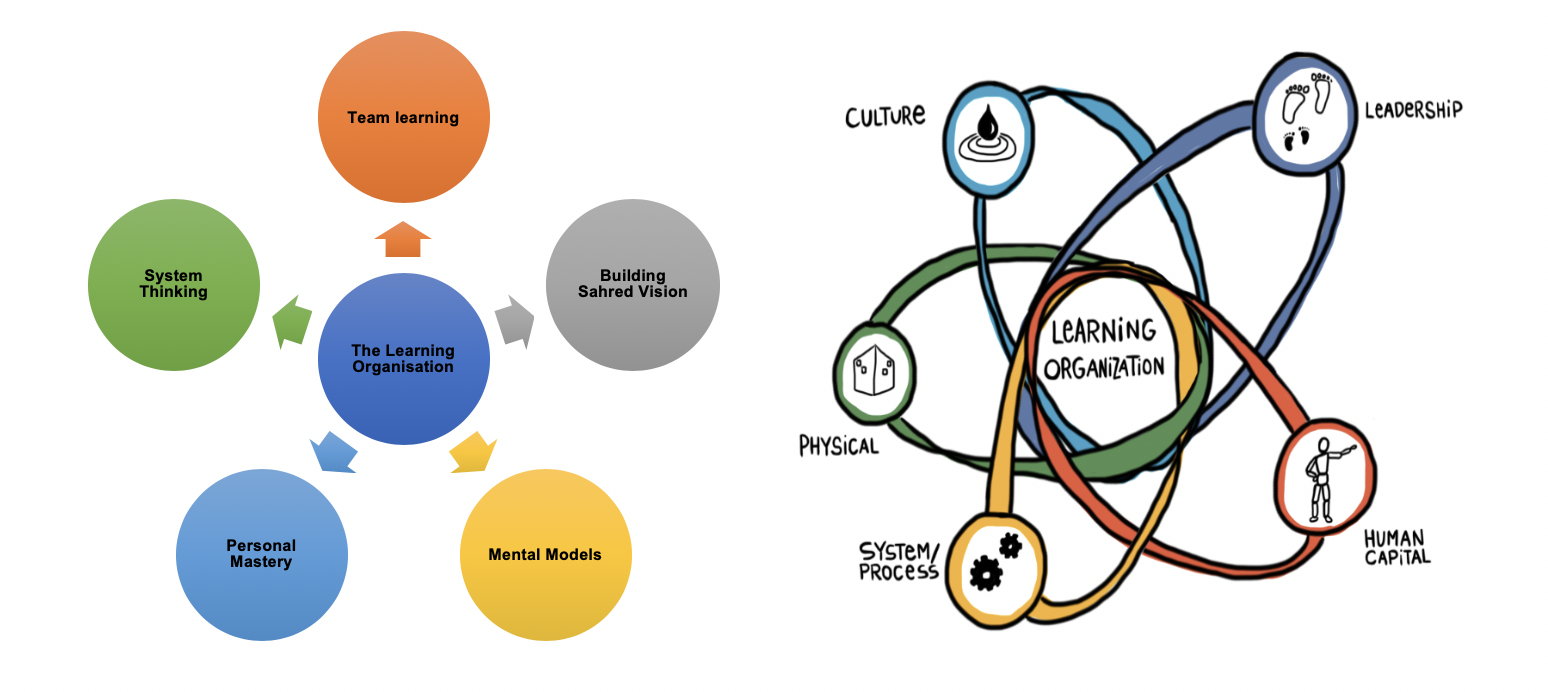
This blog will demonstrate that a good leadership style irrespective of being masculine or feminine base, must be able to handle the company as being the learning organisation to be effective. According to Kerman et al. (2012), learning organisation describes the company as the ideal environment for learning and fine-tuned with the business goals. The characteristics of company as a learning organisation is shown in Figure 1. Hence, the employees can quickly increase their capacity for creating the desired outcome beneficial to the company through an effective contemporary leadership style.
Figure 1: Characteristics of company as a learning organisation
Source: https://muhammadirfan08.files.wordpress.com/2014/09/learning-organization.jpg
3. Use relevant example: Sainsbury’s As a Learning Organization and The Role of Leadership
Sainsbury’s holds the clear vision to become the most trusted supermarket that can attract potential employees (Karim et al., 2012). Sainsbury’sheritage can be traced back since it first operated in 1865 and is considered the company’s core value (Craven et al., 2018). Most potential employees would think of Sainsbury’s as a good workplace that can nourish by applying learning and development at the activities for achieving and meeting its vision (Karim et al., 2012). At Sainsbury’s, the training process was set up to ensure the highest employee standards by including material for learning, experience of training, assessment and finally taking the learner’s feedback.
4. Use relevant example: Sainsbury’s Authentic Leadership and Ethics
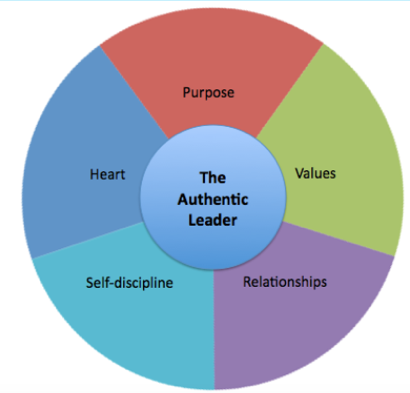
Authentic leadership is a type of management style in which people act in a real, genuine and sincere way that is true to who they are as individuals (Avolio & Gardner, 2005). Authentic leaders try to integrate and are committed towards the core ethical and moral values for effective outcome in the long-run with other characteristics shown in Figure 2.
Figure 2: The Authentic Leadership Diagram
Source: https://infograph.venngage.com/p/86148/5-characteristics-of-authentic-leadership
Figure 2 shows that the authentic leaders attempt to develop the motivational ethical behaviour in the employees through displaying values, good behaviours and attitudes by the leaders. In this way, the authentic leadership style is similar to the ethical leadership style as defined by Northouse (2018) by showing morals and values in a management system through upholding more principles in the day-to-day business operations and decisions (Ferrell & Fraedrich, 2015).
As mentioned earlier, it is shown that Sainsbury’s leadership resembles in certain aspects of the authentic leadership. At Sainsbury’s, it is possible for work to be completed and provide employees with their satisfaction. This reflects the self-awareness element of authentic leadership. However, the interpersonal dimensions reflect the unethical behaviour. It follows that the leadership style adopted by Sainsbury’s follows the approach towards the manager as arrogant, and the employees are pushed to their limits.
5. Discussion
It is demonstrated thatSainsbury’s has been a learning organisation and willing to adapt different contemporary leadership styles to today’s changing world. Good and effective contemporary leadership style is fundamental to organizational learning. Learning is the only sustainable method of achieving competitive advantage for contemporary organizations including Sainsbury’s because of rapidly changing of both macro and micro environmental forces. It is vital for all organisation through good and effective leadership to have an impulse to learn and be imprinted amongst their employees.
References
Avolio, B. J., & Gardner, W. L. (2005). Authentic leadership development: Getting to the root of positive forms of leadership. The leadership quarterly, 16(3), 315-338.
Craven, N., Patterson, S. and Forsyth, L. (2018). Supermarkets Asda and Sainsbury’s ‘in talks’ over merger. [online] Mail Online. Available at: https://www.dailymail.co.uk/news/article-5668707/Supermarkets-Asda-Sainsburys-talks-merger.html [Accessed 28 May 2019].
Daft, R. L., & Marcic, D. (2016). Understanding management. Nelson Education.
Fearne, A., & Hughes, D. (1999). Success factors in the fresh produce supply chain: insights from the UK. Supply chain management: an international journal, 4(3), 120-131.
Ferrell, O. C., & Fraedrich, J. (2015). Business ethics: Ethical decision making & cases. Nelson Education.
Karim, M. R., Huda, K. N., & Khan, R. S. (2012). Significance of training and post training evaluation for employee effectiveness: An empirical study on Sainsbury’s Supermarket Ltd, UK. International Journal of Business and Management, 7(18), 141.
Kerman, B., Freundlich, M., Lee, J. M., & Brenner, E. (2012). Learning while doing in the human services: Becoming a learning organization through organizational change. Administration in Social Work, 36(3), 234-257.
McCleskey, J. A. (2014). Situational, transformational, and transactional leadership and leadership development. Journal of Business Studies Quarterly, 5(4), 117.
Northouse, P. G. (2018). Leadership: Theory and practice. Sage publications.
 knowladge

Seeing how Sainsbury’s manage like they have the training process to increase employee performance excellence, I was not surprised why Sainsbury’s gain the most trusted supermarket in the UK.
ถูกใจถูกใจ
Thank you for your comment!
ถูกใจถูกใจ
I have never thought about this before, thank you for writing this.
ถูกใจถูกใจ
Thank you for your comment. I will keep doing the make a next blog
ถูกใจถูกใจ
Nowadays, women are able to be good leaders. The Sainsbury sees this so they have idea to adjust the leadership to suit the era. I think that good opportunity for women to show their ability.
ถูกใจถูกใจ
Thank you for your comment.
ถูกใจถูกใจ
Sainsbury’s is a powerful organization. To stimulate their employees to work.
ถูกใจถูกใจ
Thank you for your comment.
ถูกใจถูกใจ
In overall, i think this article was interesting and showing how Sainbury’s managed the organization, However, these would be more interesting, if you provide more information and demonstrate how things are related to each others.
For example, At the chapter 2, you did mention to masculine and feminine based management, unfortunately you did explain why these concept were useful.
ถูกใจถูกใจ
Thank you for your comment. I will find some information for you
ถูกใจถูกใจ
People nowadays rarely adapt to the world , still use the old way to manage the company but sainbury has demonstrated how to adapt to the world market today
ถูกใจถูกใจ
Generally speaking, the article made me know more about Sainsbury’s and its internal organisation. I think this organisation is very good at managing their employees even in hard situation or in high competitive market from overseas. This content is adaptable to others in this industry also.
ถูกใจถูกใจ
Thank you for your comment.
ถูกใจถูกใจ
There is no doubt that Sainsbury is one of leaders supermarket in UK. There are Sainsbury everywhere, in every corner in town. This article amplify how the leadership affects the team management. However, if you add more Sainsbury’s management strategies compared to other supermarkets such as Tesco, and point out the difference would make this article more interesting.
ถูกใจถูกใจ
Thank you for your comment.
ถูกใจถูกใจ
Great idea to use Sainsbury’s as a case study
ถูกใจถูกใจ
This is a good illustration of the changing styles of contemporary leadership. Leadership theories may help you become a better leader. I fin d Today’s leaders are more free and more democratic. Do you think it is a good tendency?
ถูกใจถูกใจ
well done. can you give an example for the authentic leadership?
ถูกใจถูกใจ